

The Trump administration has finalized an immigration rule that will change the H-1B selection process to favor individuals in senior positions, by providing more weight to applicants in higher salary bands.
Our Client Alert sent out in September of this year detailed how this change would impact the H-1B selection process, and encouraged public comments. Yet despite receiving almost 17,000 comments on this proposed rule, the Department of Homeland Security published the final rule without changes on December 29, 2025.
What this means for H-1B registrants
This rule amends the H-1B work visa selection process “to prioritize the allocation of visas to higher-skilled and higher-paid” immigrants. It requires USCIS to use the four prevailing Department of Labor salary levels to “weight” the lottery in favor of individuals in positions that require more experience. Prior to this rule, all H-1B registrants had an equal chance of selection via a random lottery.
With this new rule, registrants offered a position that corresponds to a Level IV salary will have four chances to be selected, a Level III registrant three chances, a Level II registrant two chances and a Level I registrant one chance.
As such, early-career applicants will be at a disadvantage compared to those in a higher position.
How salary levels are determined
Prevailing wages are determined by the U.S. Department of Labor, and all wage data can be accessed via an online wage search. For example, an “Engineering Technologist” in Albany County, NY making the equivalent of $31/hour (just slightly above average) would likely be considered a Level III registrant and would therefore have three chances to be selected. Someone with the same title in the same location making $24/hour would likely be considered a Level 1 registrant and would therefore have only one chance.
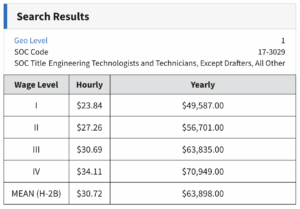
Source: OFLC Wage Search
What this means for employers
H-1B temporary visas are often the only way for high-skilled foreign nationals to work in the United States long term. This rule change will pose a barrier for companies looking to hire employees via H-1B, especially if they are hiring in the lower level salary bands.
Unless it is blocked, the rule will take effect in 2026 before filings begin for the FY 2027 H-1B cap. However, business and university groups are expected to challenge the rule in court.
Timeline
-September 24, 2025: Rule originally introduced
-December 29, 2025: Final rule announced
-February 27, 2026: Rule will take effect
Additional considerations
-Potential litigation and delays: Though finalized, implementation may be postponed pending additional court review and challenges.
-Employer evaluation: Consider your current workforce needs and realistic ways to make adjustments, as well as long-term strategic adjustments.
-Consider alternative visa strategies: Consider alternative visa options that might work for you or your business, such as the L-1 Visa. While the H-1B Visa is capped at 85,000 per year, the L-1 Visa does not have that limit.
We recommend that employers and foreign nationals impacted by this proposal consult counsel promptly to evaluate risks, and to make any further plans needed for FY2027 H-1B cap season.
We are here to help
If you would like assistance assessing how this may affect you or your business – including filing strategies, compliance planning, or addressing urgent deadlines – please contact the KLF immigration professional with whom your normally work or call us on our main line at (212) 495-9245 or email us at info@klugfirm.com.
Disclaimer: This Client Alert is for general information purposes only; it does not constitute legal advice. Actual application of laws and policies may vary based on your specific facts.